Java Street Pier

4068671523_4b0d3e422e.jpg

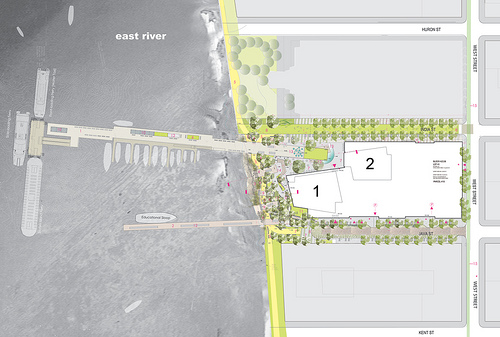
Stiles Properties’ proposed Java Street (bottom) and India Street piers, as seen in a 2009 rendering.
Source: Architects Newspaper


Last month, the City’s Economic Development Corporation issued an RFP for the redevelopment of the Java Street pier. This is the only City-owned pier on the North Brooklyn waterfront (it’s actually a pier in concept only – the actual pier structure was demolished in 2000). EDC’s current call for proposals seeks to carry out that mission, by transferring ownership of the .

EDC’s RFP says that the agency

aims to identify and select a qualified and experienced developer that has the financial capacity to construct improvements on the Site, including a new pier structure that will allow for vessel moorage and provide local residents with safe and enjoyable access to the East River waterfront.

Public access to the waterfront is sorely lacking in Greenpoint*, so any progress on this front is a big step forward. But according to Councilman Steve Levin’s office, this may all be part of a deal between EDC and the developer of an adjacent waterfront site, Stiles Properties. According to Levin, Stiles and EDC have already applied to the Army Corps of Engineers to start the construction of the pier.

So what’s in it for Stiles? Three words – FAR. Even though this property is in the middle of the East River, it is still a “parcel of land”, and it comes complete with development rights, zoning restrictions, etc. Stiles owns the adjacent property between Java and India Streets, west of West Street. With its R8 zoning, the ±18,000 square feet of (underwater) land would generate up to 40,000 square feet of additional development rights by Levin’s calculations. Those development can only be transferred to adjacent properties (like the one which is owned by Stiles Properties).

Is this a bad thing? That’s not entirely clear. Greenpoint needs access to the waterfront, and an innovative public/private partnership may be what is needed to kickstart a very moribund development environment on the Greenpoint waterfront. Certainly the City isn’t in a position to build out the pier and provide the public amenity. So this may be the best way for the City to follow through on its promises from six years ago, and for the Greenppoint community to start to reclaim its waterfront.

But as an adjacent property owner, Stiles is in a unique position to capitalize on the development rights here (as is the owner of the block to the south, who – by the way – claims that he owns part of the site that the City is trying to transfer). Stiles presented plans for a Java Street pier to Community Board 1 almost a year ago. The fact that Stiles has already applied to construct a pier on Java Street indicates that they have some expectation of winning the RFP. The RFP itself is very aggressive in its timeline – it has a one-month turnaround (sorry – the deadline already passed), and requires that applicants demonstrate that they are “prepared to commence construction within six (6) months of closing and complete construction within eighteen (18) months of commencement”. And with the work their architects (Pelli Clark Pelli) have been doing over the past couple of years, Stiles has a clear advantage in the requirement to submit architectural plans on short notice.

The transfer of the air rights is – presumably – as of right. Assuming that the additional floor area can be squeezed into the height restrictions of the existing zoning envelope, the floor area can be moved from underwater onto land through a zoning lot merger. No special permits or other discretionary actions that would trigger public review are required (although it may be subject to some review for disposition of City-owned property). (Stiles has a separate proposal to generate floor area by acquiring India and Java Streets themselves – that would be subject to additional public review. It’s not clear if that is still on the table, or if this pier acquisition makes it moot.)

The RFP raises other questions. It says that the use of site must “serve a public purpose”, but what are the requirements for public access? Would it be transferred to City Parks as other waterfront esplanades and piers are required to be? Would it be open to the public at all hours, or would it be treated differently? Will the additional floor are generated come with a requirement to build 20% affordable housing, or is it all market rate?

In the end, a lot of the concern is about transparency. Greenpointers were upset when the Palin development on the block to the north (India/Huron) went up to 40 stories by moving existing bulk within the same property (no additional FAR was generated in that move). But that was done with a public review. This proposal would increase the as-of-right development by 6% or more – from 660,000 sf to approximately 700,000 sf, all without public input on the design and use of City-owned property or any public review at all.

****
* No private developments have broken ground in Greenpoint, so the waterfront esplanades that you see going in at Northside Piers and the Edge are far off in Greenpoint’s future. The City recently broke ground at Transmitter Park (expected to be completed for Summer, 2012), and has constructed a small park at the head of Manhattan Avenue. Larger open-space projects in Greenpoint are on hold – 65 Commercial Street is stuck in MTA limbo, Barge Park is awaiting the demolition of the Sludge Tank and Bushwick Inlet Park is waiting on the City to take action to acquire a series of (environmentally suspect) private sites.


✦✦

Remaking the Face of Brooklyn

The Times is out with a quick article on Karl Fisher and the Brooklyn condo boom. Fisher (along with Bob Scarano and a handful of lesser lights) are certainly responsible for changing the face of North Brooklyn. But with “only” 50 buildings to his name over the past 8 years, Karl’s output pales in comparison to his late 19th-century peers. Architects like Theobald Engelhardt would routinely design 50 or more buildings a year.

[It sure sounds as though I am hiding behind “what other people think”, but that was the question the reporter put to me. It’s always strange to see 15 minutes of conversation boiled down to one quote.]


✦✦

Vans Coming to Greenpoint and I'm Going to Tumblr

Movable Type and SQL are annoying me lately, so I’ve (at least temporarily) set up shop at Tumblr – at least for the linked posts. My latest over there – Vans is opening up a 20,000 sf retail shop in Greenpoint – smack dab in the middle of what should be Bushwick Inlet Park (I hope its a short lease).

(PS – if you haven’t noticed, I’m also on Twitter. None of this social media stuff is aggregated yet, but I’m working on it.)


✦✦

Williamsburg’s ‘First Wave’ Restaurants

Inspired by the closing of Relish, Eater looks at eight neighborhood restaurants that are no longer. I’m not sure that I would include Coney’s among the first-wave Williamsburg restaurants, and Bonita only counts if you’re looking at Southside pioneers (2002 is way too late for “first wave”, no?). Still, some great old neighborhood restaurants, including Oznot’s (ca. 1994? – a true first waver) and Brick Oven Gallery (which happily has been reincarnated at Kenny’s Trattoria down the block).

So long as we’re strolling down memory lane, why not go all the way? What about the L Cafe and Planet Thailand (the Bedford Avenue one, not the bloated pan-Asian disaster on Berry)? What are the other true “first wave” Williamsburg restaurants – it’s a short list, but I know I’m missing some.

(And for extra credit – what was the name of the restaurant that occupied Diner before Diner? It was started, ca. 1995?, by a female chef from Manhattan.)


✦✦

Lentol Sponsors Legislation to Close Radiac

Joe Lentol is sponsoring legislation to outlaw the siting of radioactive storage facilities within 1,500′ of schools. This legislation – inspired by Luis Garden Acosta’s “toxic-free school zone” idea – would force Radiac, located at the corner of Kent and Grand, to cease radioactive waste storage. (As Luis says, if we can have drug-free school zones, why can’t we have toxic-free school zones?)

Lentol’s press release is reproduced in full, below:

Legislation to Close Radioactive Waste Site, RADIAC, Next to Elementary School Passes Both Houses

Legislation Forbids Radioactive Waste Facilities Within 1500 Feet of Any School
Assemblyman Lentol Urges the Governor to Sign the Legislation into Law

Assemblyman Joseph Lentol (D-North Brooklyn) is thrilled to announce that legislation he wrote and sponsored making it illegal for Radiac Research Inc., a radioactive waste storage facility, to continue to operate at its current location in North Brooklyn has passed both the Assembly and Senate. The legislation is on its way to Governor Patterson and Assemblyman Lentol urges the Governor to sign the legislation into law.

“This legislation would be a real victory for the North Brooklyn community and the safety of our children,” said Lentol. “I want to thank Senator Martin Malave Dilan for sponsoring it in the Senate and all of my colleagues in the legislature for helping me to take this important step towards ensuring that there is a plenty of space between our children and radioactive waste.”

At issue is the company’s close proximity to a local elementary school PS 84; so close it is actually in violation of NYC code. Despite the site typically storing medical low-grade radioactive waste that many experts see as relatively safe to store, Assemblyman Lentol refuses to gamble with the health of his constituents. This has been an especially worrisome because the City of New York has recently closed Fire Company 212 which was the engine company specially trained to deal with facilities such as RADIAC. Also, the Department of Justice has stated that such facilities are at high risk of terrorist attacks.

Lentol believes that any company storing radioactive waste should not be located in such a populated area. “No one wants to live next to a dump, let alone one that contains radioactive waste. It is only common sense that my constituents be safeguarded against potential health hazards that are completely avoidable. It is appalling that the students in this community are going to school next to radioactive waste, if the Governor signs this legislation it will be a real victory for the environment for health, for safety and for our children,” said Lentol.

Assemblyman Lentol teamed up with local students from the El Puente Academy for Peace and Justice to create the legislation. The legislation prohibits any kind of radioactive waste facility within 1500 feet of the boundary of a school. In order to write the legislation Assemblyman Lentol needed to know exactly how many feet were between PS 84 and the toxic waste facility. So as a special project, the math class at El Puente went out in the community and measured the exact distance.

“El Puente’s over 20 year struggle, launched by our Toxic Avengers and, today, embraced by all, is poised to take a major step in reclaiming the safety and environment of our communities, especially, our school young. With Governor Patterson’s support we look forward to ‘Toxic Free School Zones’ across New York State, heralding our human right to clean air, green and open spaces as well as renewable, sustainable energy. Our schools can, now, teach another ‘R’ – the Right of North Brooklyn and all communities to peace and environmental justice,” said Luis Garden Acosta, the founder, president and CEO of El Puente Academy.

“El Puente has a long history of being involved in community and the environment and without them this legislation would not exist. This hands on project gave students the opportunity to learn not only math but also about the environment and government. I am grateful for their crucial role in this process,” said Assemblyman Joe Lentol. “It is my hope that these students’ work will go the full length of the process and be signed into law by Governor Patterson,” he continued. “If it does, those students will have played a crucial role in protecting all of the students who come after them. They should be very proud,” said Lentol.


✦✦

Kedem Winery Soundstage

kedem.jpg

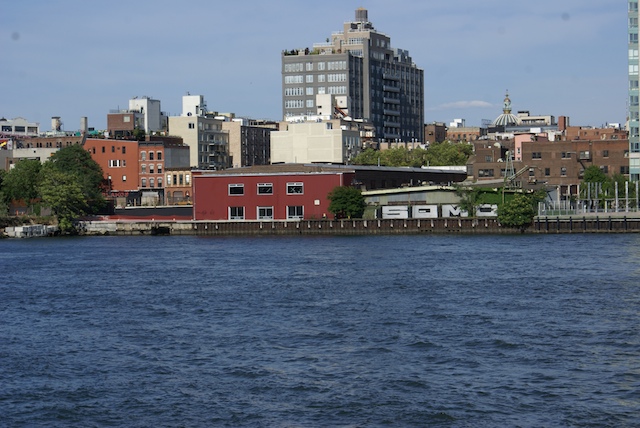
CineMagic’s Riverfront Studios will be located in the big red building with the brand-new windows.

Yesterday I mentioned that 420 Kent Avenue (part of the former Kedem Winery site) was undergoing a major rehab (something a bit more than the “interior renovation of storage garage” described on the Alt-2 application). My information was correct – the property is being converted into a massive soundstage facility for movie and video production. According to a listing of production facilities put together by the citystate, CineMagic’s Riverfront Studios at 420 Kent Avenue will include five stages (River Stage, Schaefer Stage, Rooftop Stage, Skyline Stage and Daylight Stage) totaling more than 60,000 square feet. The people behind this operation already operate a small stage on Elizabeth Street in Soho (the website for the Williamsburg facility isn’t live yet).

Given the investment required to put together a major facility like this (which I assume CineMagic wouldn’t do without some sort of long-term lease), I’m betting that owner Rector Hylan has no imminent plans to build residential here.


✦✦

Kedem Winery Site Wants More Time

Aaron Short just pointed out this RealDeal post to me – Rector Hylan, the owner of the former Kedem Winery site (south of Giando, north of Schaefer) has filed for an extension on the special permits it was awarded in 2006. The Kedem site was approved for a rezoning in 2006, and as part of that rezoning, the owner received special permits to reallocate height and density within the site (similar to the special permits that went along with the Domino and Rose Plaza rezonings). The zoning (when it is enacted) is forever, but special permits expire – in Kedem’s case, in about two weeks. The extension would run for three years.

The real story here is the work that has been going on at the site over the past six months. According to DOB, the recent work at 420 Kent Avenue involves “interior renovation of storage garage” with no change of use. The work is somewhat more substantial than that – involving the refacing of the building, the paving of the adjacent parking lot and a ton of interior work. From what I have heard, the building is being rehabbed as some sort of soundstage. Up the block, the blocked up windows of 420 Kent Avenue have been opened up and new aluminum windows installed. None of this is the kind of work that one does to prep buildings for demolition, so I’m going long and betting that this site will be looking for another special permit extension in three years.

In the meantime, a site that was to be rezoned for residential use (with 20% affordable housing and publicly-accessible open space) remains anything but.

Previously:
Kedem: Spring Cleaning
Kedem – Spring Cleaning or Signs of Life?


✦✦

Analysis: Domino Approved

The City Council approved the New Domino rezoning yesterday, making some modifications along the way. The final rezoning can now be summed up in three words:

It’s still big.

For anyone who supports a progressive approach to land use and planning, yesterday’s Domino vote was nothing short of a disappointment. (And judging by the large number of people who submitted testimony to the City Council and City Planning Commission against the Domino proposal – they easily outnumbered supporters – there are a lot of disappointed people in Williamsburg today.) Despite very strong community support for a better plan, the rezoning that the Council passed is essentially the rezoning that the developer asked for. There will still be at least 2,200 residential units, and there will still be hundreds of thousands of square feet of retail and office space. And yes, those impacts are still offset by the developer’s pledge for 660 units of affordable housing (a maximum of 30% of the project) and a new 4-acre waterfront esplanade.

The changes that were made to the development side of the project really amount to rearranging deck chairs. They certainly don’t address any of the core objections raised by Community Board 1 or Borough President Marty Markowitz (who still has issues with the project). The height of the two tallest towers are reduced by 60′ each (to 34 stories), but that floor area is just reallocated within the development site. And one of the few changes made by City Planning – reducing the height of one of the office towers – is undone by the Council. The net effect is no reduction in density, no offsetting of the per capita reduction in open space for Williamsburg (a “statistical fractional decrease” in the words of the developer – an actual reduction in available open space to you and me), no mitigation of shadow impacts on Grand Ferry Park or neighboring row houses, and no improvements to an overburdened transit system (other than a shuttle bus to make it easier for Domino residents to get to the overburdened transit system).

In short, the New Domino continues to employ a new math – one that says that 5,000 to 6,000 market-rate (i.e., luxury) tenants somehow won’t permanently change the character of a working class Latino neighborhood (prediction – it will). At 2,200 units (minimum), Domino will increase the local population by about 20%. And that assumes that all 330 of the affordable housing units set aside for residents of Community Board 1 go to residents of the immediate neighborhood (prediction – less than half that number will).

There are some truly positive changes that came out of the Council negotiations, all of them courtesy of the city (and your tax dollars).

First off, there is the city’s commitment to continue funding the Tenant Anti-harassment Fund. One of the effects of the gentrification of Greenpoint and Williamsburg has been increased harassment of tenants, particularly those in rent stabilized or rent controlled apartments. The addition of 1,540 new market-rate units is only going to make the problem worse on the Southside. A consortium of community groups has been fighting this trend – with very tangible results – for a few years now. Now that initiative will continue. The question is, will the initiative continue through the development of the entire Domino project (a ten-year horizon), or is the City just going add a year or two onto the project?

The other big win for the community is the funding of a district-wide transportation study. Again, pretty dry stuff, but this is something the community has been asking for for over 7 years (since well before the 2005 rezoning). We’ve seen the results of ad hoc transportation planning, and they aren’t pretty. Done right, a district-wide transportation study might even lead to a comprehensive transportation and transit plan that will address some of the burdens that projects like Domino (and many, many others) will bring to this transit-poor neighborhood.

There are other benefits for the community at large, including additional capital funding for parks and a capital contribution to a community cultural center (Northside Town Hall, I believe). Of course these promises get added to the long list of promises from the 2005 rezoning (many of which remain unfulfilled). And the big thing that the City could have done to mitigate the reduction in open space Domino is bringing to the neighborhood – creating new parkland – remains a dream.


✦✦

Domino Rezoning: In the News

Two Council committees (Zoning and Land Use) approved the compromise Domino plan yesterday. Because of the modifications, the plan now goes back to the City Planning for a re-review to make sure the changes are in scope with the EIS. After that, it returns to the full Council sometime in July for a final vote. Here is a selection of reporting on the City Council’s approval of the Domino rezoning:

City Council Passes the Sugar [Chaban in A|N – best summary of the nitty gritty]

$1.4 Billion Development at Sugar Refinery in Brooklyn Wins Key Council Support [Bagli in the Times – some of the details here are incorrect]

Council, Mayor Cut Deal to Salvage $1.5 B ‘New Domino’ Project for Willliamsburg [Calder in the Post]

Embattled “New Domino” Project Scores Big City Council Win [Gothamist]

A Big Domi-YES from the Council [Short in BP]

Another “Domino” Falls for Landmark Development Deal [NBC]

Council Committees Approve Domino Redevelopment Project [NY1]


✦✦