Williamsburg, It Is Like Rock ’n’ Roll for Kids

Well this is sure to fan the Williamsburg-is-dead flames into a full-fledged bonfire of the inanities.

Yes, the NY Times (the paper of record, whose discovery of Brooklyn clearly is not letting up) has anointed Williamsburg safe for children.

Through his living-room window, Mr. Signer can see the Domino Sugar factory and the Williamsburg Bridge, partly obscured by the steel beams of new construction — just the industrial feel he wanted.

The “steel beams of new construction”? Yes, that would be the rusted hulk of a stalled project on North 1st Street that has seen no activity for a year and a half, ever since construction workers nearly brought down a 175-year-old building next door. (They weren’t actually humming along prior to that, either.) Enjoy that view, though. Someday, that building will be completed (odds are it won’t be anything to look at) and the Domino factory and Williamsburg Bridge will obscured by the towers of the New Domino.

For an article all about raising kids in Williamsburg, it’s pretty light on the school situation. In an article all about 80 Met, Warehouse 11, The Edge and Northside Piers, there is praise for PS 132 (well east of BQE) and PS 34 (in Greenpoint), probably the two best elementary schools in North Brooklyn. But no mention of PS 84 or PS 17, the schools that most of the people interviewed would be zoned for.

It’s also interesting to hear all the developers talk up their family-sized apartments – when most of these buildings broke ground, they were focused entirely on studios and one-bedrooms.

Full disclosure: I have two kids, and I actually do think that Williamsburg is a good place to raise them. Even though the schools aren’t that great, and the ones that are pretty good are way over crowded. And even though there aren’t enough proper playgrounds or parks (yeah, Play and Miss J’s and Klub for Kidz are great in the middle of January, but come springtime, they don’t make up for one of the lowest per-capita open space ratios in the City). Hopefully these new families in the neighborhood will get involved with some of the local groups that are trying to make the neighborhood better.
Marshall’s and CVS on Bedford Avenue?

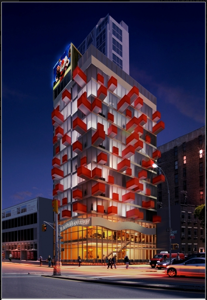
242-bedford.jpg
242 Bedford Avenue
Photo: The Real Deal

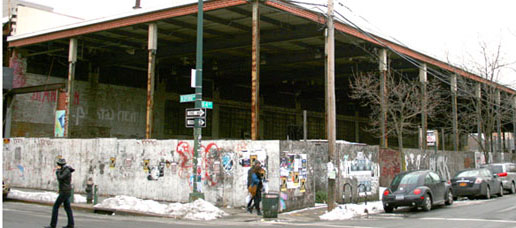
The Real Deal has an article saying that discount clothing retailer Marshall’s and drugstore may be coming to Bedford Avenue. The location in question is 242 Bedford Avenue, the rusted hulk at the corner of Bedford and North 4th. According to the Real Deal, the owners of the property – the Backer Group – had an agreement to sell the property, but has also gone into bankruptcy to forestall a foreclosure by Capital One Bank. As the article says, “the Backer site has a complicated background.”

Actually, that ain’t the half of it. The building (which until a few years ago housed a art framing company and other industrial tenants) was part of a larger urban renewal site that was developed in the late 70s or early 80s. The urban renewal area included the small brick townhouses along North 3rd and North 4th and the property that is now under construction by Quadriad (the Duane Reade site). Even though the block is zoned for residential use, because of the urban renewal designation, the site was restricted to manufacturing use through (I think) December, 2009.

In the fall of 2007, Backer sought the support of the Community Board to build a Commerce Bank on the corner of Bedford and affordable housing in much of the rest of the building. The Community Board (along with Council Member Diana Reyna) didn’t buy into the project, mainly because all of the affordable housing would have been studios. Without the support of the Board and Council, the owner had no hope of undoing the urban renewal designation early, so the project went away and the site continued to sit vacant. (In that sense, the Real Deal is wrong when it says that this is a stalled site – there never was a project to stall.)

The Backers, by the way, also own the large property on the other side of Bedford, which houses, among others, the Bagel Store. That site has been the subject of other retail (and chain) rumors ever since the landlord threw out the potential of a Starbucks coming to the building. I may be wrong, but I still think that was a just a “for instance” negotiating tactic on the landlord’s part, and that there is no deal to bring a Starbucks to that storefront (the Bagel Store lease won’t be up for another year or so – again, if Starbucks wants to move into the neighborhood, why would they wait two years to do so?). Regardless, between Commerce Bank and Starbucks, there is a history of retail teases here.

As for Marshall’s, I’m guessing no way. CVS maybe, but Bedford Avenue does not seem to fit Marshall’s M.O. at all. They are a retail chain that depends on auto, not foot traffic, and (typically) goes for larger stores in mall or shopping center settings. CVS is already building a store three blocks away (at the Edge), but as Duane Reade as shown us, drugstore chains have no qualms about cannibalizing their own business. And if DR is on Bedford, you can bet that CVS isn’t too far behind.

Still, the last thing Bedford Avenue needs is another side-by-side pairing of drugstores. With any luck, this site will become the grocery store that Williamsburg desperately needs (hopefully that doesn’t mean the mother of all Khim’s Millenium Markets, though). Or maybe this will be our long-promised Apple store.

Demographic Shift as Minorities Move to Suburbs

The Times has two interesting articles based on the latest data dump from the Census Bureau’s American Community Survey. The first article looks at local trends, and finds that

Metropolitan New York is being rapidly reshaped as blacks, Latinos, Asians and immigrants surge into the suburbs, while gentrification by whites is widening the income gap in neighborhoods in Manhattan and Brooklyn

Neither trend is particularly surprising if you’ve been paying attention. Inner suburbs, like Nassau County on Long Island or Fairfax County, Virginia, have been seeing large influxes of minorities – Asian and Hispanic in particular. Outer exburbs – Orange County, NY, for instance – have also been seeing large increases in minority population. This trend – and some of its implications – is explained much better in the Times’ second article, which focuses on national trends.

Locally, the Times picks up on the countervailing trend of gentrification by whites – again, no surprise to anyone who has lived in Williamsburg, Greenpoint or Bushwick (to name but three of many impacted Brooklyn neighborhoods). The accompanying maps show that the Hispanic population in Williamsburg has gone from 40% to 30% over the past decade. What it doesn’t say is how much of that shift is displacement and how much is a general increase in the non-Hispanic population while the Hispanic population remains flat or rises at a slower rate. I suspect it is some of both, but need to spend some time with the numbers behind the survey (this will also be illuminated much more clearly when the Census Bureau releases its 2010 numbers – what we are looking at right now is an annual sample survey, not a straight count of all bodies).

Duane Reade – Oh Noes!

Oh great, now the Guardian (UK) is on the Duane Reade story. Must be news.

Give me a break.

It’s not news.

It’s a drugstore.

A shiny new, clean and characterless drugstore (I never thought I would use the words “shiny”, “clean” or “characterless” in describing a Duane Reade, but there you go). The second such shiny new, clean and characterless Duane Reade to open on the Northside in the past year.

In an article practically oozing with ridiculous Williamsburg stereotypes – hipsters, beards, tattoos, piercings, lifestyles “funded by middle-class parents” (in Ohio, no doubt), and rumors (rumors) of a Starbucks (a boogey man we’ve been hearing about for 15 years) – the Guardian tries to find deeper meaning in the opening of a new Duane Reade in a ugly condo on Bedford Avenue.

There isn’t any deeper meaning. It’s a drugstore. A lot of the “poor… Jewish, eastern European and Hispanic working-class immigrants” who populated the neighborhood until a decade ago are probably just fine with a new drugstore. But who knows? – the Guardian (and every other newspaper that has decided that this is “news”) didn’t interview anyone who has lived in the neighborhood for more than 7 years. The basis of the entire article is that people who have lived here for less than a decade are being forced out by the taint of corporatism. Other than acknowledging that there were groups of people who lived here before 2000 (but no artists or non-ethnic white people, apparently), there is no attempt to find out what longtime residents think about this – or even if, and more importantly, to what extent, those residents are moving/have moved out of the neighborhood.

Maybe the longtime residents aren’t shopping at Duane Reade. Maybe they don’t need growlers and frozen frat food. Maybe they like their neighborhood pharmacies but don’t sign petitions. (BTW – has anyone actually comparison shopped between DR and King’s? My scientific sampling shows that they both charge exactly the same amount ($10.99) for a bottle of contact lens solution, but that King’s has way better music).

The only sane person in the entire article is Josh Freeman, history professor at CUNY, who notes “Cities and neighbourhoods change all the time. You can’t freeze them. You don’t want to create a sort of museum”.

Amen.

So shop where you want. Just shut up about it. And remember, it’s just a drugstore.

Post #500

As you might have noticed, things have been quieter than usual around here. In addition to a flood of work, a busy semester and a lot of local activity, my Movable Type installation went haywire on me a couple of months ago. Unfortunately, MT support has declined to almost nil (at least for semi-pro bloggers like myself who don’t want to pony up a few hundred a year for paid support) – it now consists of two or three very knowledgable people on the MT forums. I suppose Six Apart knows what it’s doing, but I don’t want anything to do with it (maybe that’s their point).

So, after more than 8 years using Six Apart’s Movable Type, I’ve now moved everything over to WordPress. Bit the bullet and figured out PHP. I started out by launching a side project (because I don’t have enough to do), and then worked on shifting Brooklyn 11211 over – 499 regular posts and over 1,000 linked list posts since I relaunched the site in 2007. I’m still getting used to it, and there are still some kinks (don’t click on the “Archives” link), but for the most part I’ve been able to recreate the functionality of my MT design and add new functionality (pushing to Twitter!).

Hopefully, with all this new functionality, I’ll be able to get back to my volume of semi-regular posting.” At least I now have one less excuse for not posting.


✦✦

Shopping Local

Kings Pharmacy
Photo: via FreeWilliamsburg

So Duane Reade has come to Bedford Avenue and everyone is up in arms. Supporters like Shari Lind (if she exists) think that we need more Duane Reades, Dunkin’ Donuts and other chain stores, all in the name of convenience. Opponents like Tracy Kinney think Williamsburgers should shop locally, fight the greed and enjoy the music.

Personally, I like local shops and will probably do most of my shopping at Kings (which, by the way is also a Manhattan transplant) or Northside Pharmacy (the only true local). I won’t be “boycotting” Duane Reade, and I do hope the competition forces Kings to lower some of their more outrageous pricing.

But in terms of convenience and economy, is anyone else more bothered by the fact that we now have three large chain drug stores but still no supermarkets in Williamsburg? (Sorry, Tops doesn’t rise to the level of super.) Our fresh food needs are served by chain pharmacies, local bodegas and the overpriced chain of Khim’s Millenium stores (new location opening at South 2nd and Bedford!!). For a neighborhood that supports a bustling farmers’ market and at least three CSAs, this is insane. No wonder so many people schlep bags of groceries on the L train.

Don’t expect a real food market anytime soon – there really isn’t any place to put one. The Domino project is the only development site with the square footage for a proper (in industry terms) supermarket, but that won’t be completed until 2013 at the earliest (and will still be a car ride away for most neighborhood residents). This wouldn’t be the end of the world if there were local food shops to fill in the void – green grocers, butchers, bakers and the like. But the two local butchers have sold out to the lure of rising rents, and most of the new alternatives (as good as they are) are unaffordable to many long-time neighborhood residents.


✦✦

Does TNR Have the Funding to Build Greenpoint Hospital?

The Daily News reports this morning that TNS Development – the group that won the bid from the City to build affordable housing at the Greenpoint Hospital site – may not have the funding lined up to do the project. Specifically, TNS’s bid to the City included almost $4 million in funding from Borough President Marty Markowitz – money that Markowitz says he has not been asked for and probably wouldn’t give if he was asked for it:

‘I have not received any request for funding … nor have I made any commitment to this organization.’ [Markowitz] wrote in a letter this month to Housing Preservation and Development officials.
‘Your development staff should be familiar with my past … appropriations to realize that the sums being requested exceed the funds I have provided to individual housing projects during my tenure.’

This confirms what I have been hearing for some time now: that TNS probably does not – and will not – have the funding to do the project.


✦✦

Broadway Triangle, Still Up in the Air

In the Greenpoint Gazette, Juliet Linderman recaps the current status of the Broadway Triangle rezoning. The judge hearing the case has continued the stay on the project in light of the ongoing investigations of Ridgewood Bushwick Senior Services Corp., one of the groups selected to develop the city-owned sites in the Triangle. In the meantime, the tax abatements that were to help fund it have expired, eliminating at least one reason for quick action.

I’ve said before that the courts – not the land-use process – are the proper place to decide the issues of who got what and who got left out – the process issues. But the plaintiffs suit with regard to the land-use issues is foolish.

the lawsuit wagers that the preliminary planning meetings were exclusive, and that the overall structure of the affordable housing complexes—low-density with a disproportionate number of multiple-room dwellings—are designed specifically for Hasidic families, and neglect the needs of black and Hispanic area residents.

“Low-density” in this case means the same density as every other rezoning that has happened over the past decade in North Brooklyn (OK, with one exception), and roughly the same density as all of the high-rise projects nearby (the tower in the park configuration of these projects yields a surprisingly low density). And the zoning – the R6s and R7s – does not dictate unit size. That is decided by the developers (which goes back to the issues that should be decided in court).

And for all the attention on Ridgewood Bushwick and UJO, it’s worth remembering that the vast majority of the Triangle is privately owned. If history is any guide, those sites will not be built with affordable housing, but they will be built to the maximum building envelope allowed under zoning. And to whatever price and configuration the market will bear.


✦✦

Making 'Fair Share' Fairer

Gotham Gazette has an excellent piece out about the changes to “fair share” proposed under the City’s Charter revision. In a nutshell, it will give neighborhoods like North Brooklyn (home to five or six City Sanitation garages, about half of the city’s commercial waste haulage, numerous brownfields, power plants and a sewage treatment plant).

Currently, the City Charter has a provision that is intended to take into account the impact of Sanitation garages, sewage treatment plants, and the like on a community. The provision is intended to encourage a more equitable distribution of city facilities across community districts. But the current Charter provisions only require that the City take into account facilities on City-owned sites, leaving out the environmental and social impacts happening on privately-owned land. The proposed Charter revision would take into account all “state, federal and private facilities that handle solid waste and transportation in the city facilities map”.

This is a big step forward. It certainly is not a perfect fix – the fair-share provisions only require review, not an actual fair-share distribution (witness the City’s recent approval of expanded Sanitation facilities in CD1), and the new provisions don’t take into account all impacts on privately-owned land – but as Gotham Gazette says, it is a good first step.


✦✦