Bedford Avenue Stripped of Bike Lanes

detour.jpg

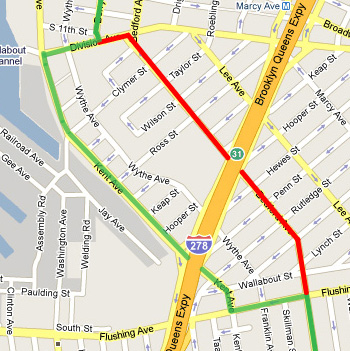
FREEWilliamsburg says it’s bullshit, and they’re right. The removal of the bike lane on a section of Bedford Avenue – the section that runs through the heart of the Hasidic community, was a bad decision, made for bad reasons. Gothamist says that the Bedford Avenue bike lane was “relatively noncontroversial”, but that is not the case at all. The bike lane was hugely unpopular with the local community, in part because it made double parking illegal, and in part because (for one rabbi in particular) of the “problem” of scantily-clad women riding through the neighborhood.

Now Bedford Avenue is a heavily-trafficked and crowded street – south of Division Avenue and North of it. Which is why south of Division the bike lane – which connects north Brooklyn to central Brooklyn neighborhoods like Clinton Hill, Bed-Stuy, Prospect Heights and Crown Heights as well as connecting all of those neighborhoods to Prospect Park and the Williamsburg Bridge – runs a block west along Berry. But there is no viable detour north of Division, which is why the City – correctly – put a bike lane on Bedford Avenue. Now that Kent Avenue has a bike lane running all the way north from Flushing, it does make sense to encourage bikes to take that route – it is safer and more protected, albeit much more indirect.

What doesn’t make sense is removing the Bedford Avenue bike lane in its entirety (and I think DOT’s “quiet” removal of the lane reinforces that). As Transportation Alternatives correctly points out, bikers have a right to ride on any public street. Removing a bike lane entirely – particularly bowing to NIMBY pressure to do so – sends exactly the opposite message. If DOT really wanted to make responsible “bike network adjustments in the area”, it would have converted the Bedford Avenue bike lane to a shared arrow (sharrows) lane – at least would have reinforced the message that drivers (and neighborhoods) need to share the road with bikers.



✦✦

Artificial Turf for Hunters Point Park?

The Daily News isn’t exactly clear about what the turf would cover (is it a “green” or a playing?) and how much there would be (an “egg-shaped green” or the 11-acre park?). But if this anything other than an athletic field, the “Parks” Department should be embarrassed.

Parks should also own up to the fact that artificial turn does not have the life-span they claim. Under normal use and with regular (weekly) maintenance, an artificial turf field can last ten or twenty years. Under constant use and with infrequent maintenance, a turf field will last about four years (I’m looking at you, McCarren Park).

CB1 Panel Block Developer’s Waterfront Towers

From last week’s Brooklyn Paper, a report on CB1’s Land Use Committee review of Rose Plaza (the site to the south of Schaefer Landing, currently occupied by Certified Lumber). The article focuses on housing – number of units and affordability – but the committee’s objections extend to areas such as public open space, industrial relocation and (some potentially very considerable) environmental issues at the site (it was once home to a manufactured gas plant).

The full board will take up the committee’s recommendation tomorrow night: 6:30 pm on Dec. 1 at the Swingin’ Sixties Senior Center, 211 Ainslie St.

Ferry Confusing

The Brooklyn Paper has a good in-depth look into the state of the East River Water Taxi service. It’s not a pretty picture – NYWT is apparently ready to pull the plug entirely, while the City is backing away from its support for subsidies and service extensions to other sites in Williamsburg and Greenpoint (which should increase ridership, thus making service overall more viable and the need for subsidies that much less).

Tom Fox of NYWT nails it when he says “ferry service will work whenever [the City] the political will”. At the same time, developers (and just the few on the waterfront) are leaving their tenants high and dry by not stepping in and supporting service. At this point just about every waterfront development has promised a water taxi landing, but no one is willing to pony up some money to make the service viable.

City’s Schools Share Space, And Bitterness, With Charters

At M.S. 126 [in Williamsburg], despite the librarian’s dismay, the principal, Rosemary Ochoa, has worked out what she considers a viable plan with the Williamsburg Charter High School and its two small spinoffs, which also occupy the building. The charters get the library for most of the day, and Ms. Tecza is expected to travel to individual classrooms to teach the public students library skills.

The City’s space planning for schools remains a nightmare, with underutilized schools (PS 84) blocks away from overcrowded ones (MS 126). And while the trend towards charter schools fills up unused space in many local schools, it does nothing to the improve the education of the host schools.

Forgotten by Time and Termites

Greenpoint_wood.jpg
Hyde & Co. Insurance Map of Brooklyn, 1898
Plate 34
Source: NYPL


The Times profiles life in New York City’s wood-frame houses – a building type that definitely has its charms and pitfalls (I live in a 175-year-old wood house, so I know both). But while they are rare in Manhattan and brownstone Brooklyn, north Brooklyn – Greenpoint in particular – is positively overrun with wood-frame houses. The map above shows the north section of Greenpoint (north of Greenpoint Avenue) in 1898 – the yellow represents wood-frame buildings and the red masonry. Other sections of Greenpoint have similar ratios of yellow to red among the rowhouses. Northside Williamsburg and East Williamsburg also have a high percentage of wood houses. The Southside has a much higher percentage of red (brick) buildings, and South Williamsburg would actually show a lot of brown (for brownstone) and very little yellow.

Most – though by no means all1 – of the artificially sided houses in Greenpoint and Williamsburg are either all wood or wood sides and rear with brick fronts. (And most of those are worse for the artificial siding, which traps water and hides water damage, but that’s another story.)

The wood houses of Greenpoint and Williamsburg are generally not as nice as the Civil War-era wood houses of Fort Greene and Clinton Hill, although there some very nice examples in the Greenpoint Historic District. Most of the wood houses in Greenpoint (particularly east of McGuinness) are late-19th century tenements, not traditional row houses.

1. With the advent of EIFS (stucco over styrofoam), there is an unfortunate trend of covering over historic masonry facades. The results are usually awful, and the benefits to the building are much less than a decent pointing job would have been.


✦✦

Isaac Hager Facing Lawsuit

The Real Deal reports that the developer of 421-431 Kent Avenue (the former Domsey parking lot) is being sued over a mortgage deal that went bad. N. Richard Kalikow is alleges that the developer, Isaac Hager, used the personal guarantee of his terminally-ill business partner to secure a $17 million second mortgage from Kalikow. The deal went through in October 2007, and Hager defaulted on the loan in August 2008. The business partner, Chaim Lax, died in November of 2008. There is also an allegation of misappropriation of funds regarding $100,000 that was set aside to hire a consultant to secure 421-a tax abatements for the project.

Hager (who also developed 20 Bayard and the Aurora) and Lax acquired the Kent Avenue site in December 2007 for $42.6 million.

Yassky’s Bargain

David Yassky’s exit interview on the Greenpoint/Williamsburg waterfront rezoning.

One lesson of that is: whatever neighborhood improvements are supposed to go with a big development plan should be done up front–should be done before it’s passed. The commitment should be made enforceable in some way. And if not, then don’t bank on it.

Words to live by.